The sample programme: Harbourside Choral Society.
An invented society: a 60-voice community choir singing Parry, Vaughan Williams and the Fauré Requiem. The email below is the chair's 600-word brain-dump the Thursday before the print deadline; the copy is about 1,300 words in programme order. Nothing about a person is in the copy that the email did not say; the notes on the three works are written fresh; the seven things the email left open are listed at the end, undecided.
Before: the committee's email, as sent.
Hi, programme copy for the autumn concert, as promised, sorry it's late, print deadline is Monday so anything you can do by then!!
Concert: Sat 21 Nov, 7.30pm, St Michael's. Harbourside Choral Society Autumn Concert. Tickets £14 / £12 conc / under 18 free (on the door and from Jane).
Pieces in order:
- Parry I was glad (we open with this, organ)
- Vaughan Williams 5 Mystical Songs - Thomas is the baritone
- INTERVAL (wine and soft drinks at the back, 20 mins. or about 15? ask Catherine)
- Faure Requiem - Thomas again + Ellie Marsh doing the Pie Jesu (she's one of our sopranos, 2nd year with us)
With orchestra - the usual players, Catherine said to say "with orchestra", she'll confirm the name.
Catherine's note (musical director) - she sent this, says tidy it however you like:
"This is a programme about consolation, I suppose, though I didnt plan it that way, I chose the Faure first because we have never done it and the choir asked for it for years and then everything else followed. Parry because its the best possible way to start a concert in a building like St Michaels and because we did it at the 40th anniversary and people still talk about it. The Herbert settings I have loved since I sang them as a student, the fourth song The Call is the one everyone knows but Love bade me welcome is the heart of it. The Faure is not a dramatic requiem, there is no last judgement, it is quiet and it is kind. We have 62 singers this term which is the most we've had since before covid. Thank you for coming. Catherine"
Bios:
Catherine Alder MD - been with us since 2014, studied at RNCM, conducts the Westfield Singers too, teaches singing, was assistant chorus master at [opera company - she'll confirm which one] for 3 yrs. Freelance before that.
Thomas Reade baritone - trained at Guildhall, sang Papageno (Magic Flute) for Opera Up Close(?) last year, oratorio all over the place, Messiah with us 2024, he's also a lay clerk at the cathedral. He sent 400 words, way too long, I've attached it, pls cut down to same length as the others.
Daniel Okafor organ - he hasn't sent a bio!! All I know: assistant organist at St Michael's, Durham organ scholar, accompanies us every term. Can you do something with that.
Ellie Marsh - she's a member not a soloist really, 2nd year with us, works as a vet nurse, does she need a bio? maybe a line.
The choir - founded 1984, about 60 singers, 3 concerts a year, no auditions, we rehearse Tuesdays at the Methodist hall, new members welcome, registered charity no. [Jane has it]. Website harboursidechoral.org.uk (made up for sample).
Chair's welcome - I'm chair (Margaret Lowe). Something short, thanks for coming, thanks to the Friends, mention we're looking for a new treasurer!! and the raffle.
Thanks list: St Michael's for the building, Revd Alan Price, the Methodist hall for rehearsals, our Friends (list from Jane, she'll send), Pete for the staging, Jane for tickets, the committee, Sarah for the posters, everyone who baked. Programme printed by Quayside Print (they give us a discount, mention them).
Next concert: carols by candlelight Sat 19 Dec 6pm, same place, then spring concert 20 March (prob Haydn Creation, not confirmed, don't print the Haydn).
NB please no song texts/translations, we had a copyright thing last year, Catherine will do a texts sheet separately.
Thanks so much, Margaret
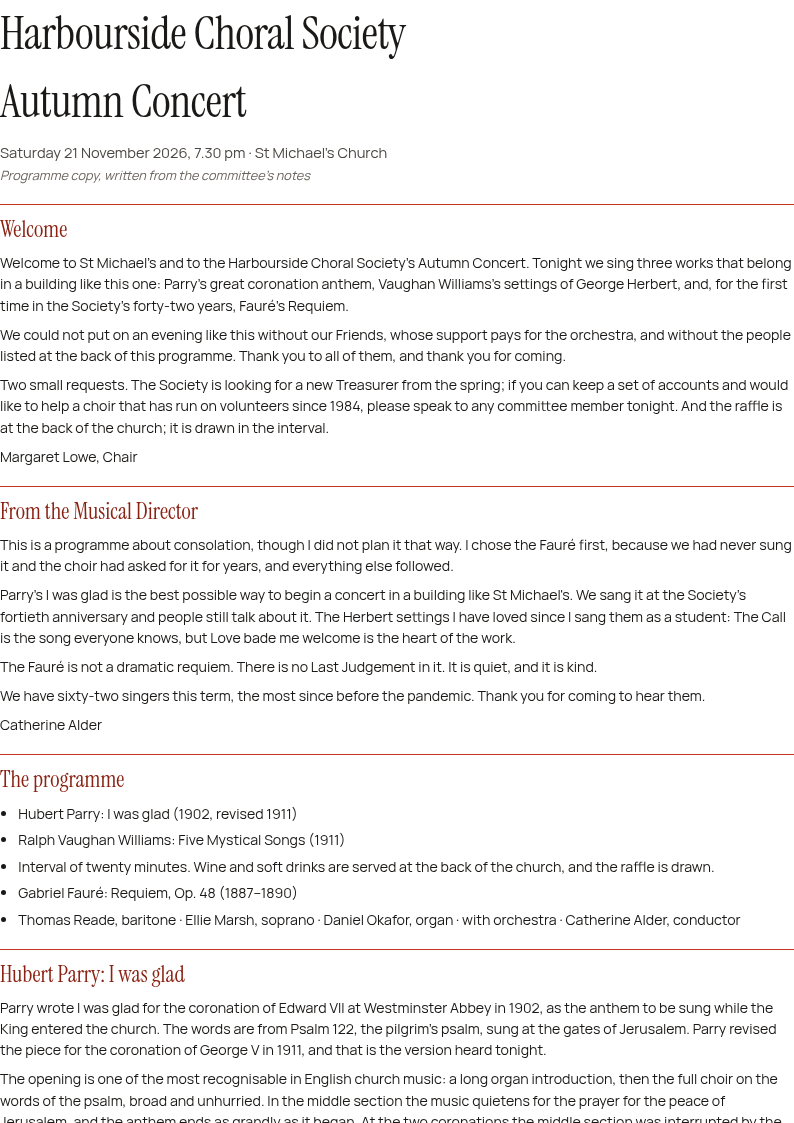
After: the programme copy.
WELCOME
Welcome to St Michael's and to the Harbourside Choral Society's Autumn Concert. Tonight we sing three works that belong in a building like this one: Parry's great coronation anthem, Vaughan Williams's settings of George Herbert, and, for the first time in the Society's forty-two years, Fauré's Requiem.
We could not put on an evening like this without our Friends, whose support pays for the orchestra, and without the people listed at the back of this programme. Thank you to all of them, and thank you for coming.
Two small requests. The Society is looking for a new Treasurer from the spring; if you can keep a set of accounts and would like to help a choir that has run on volunteers since 1984, please speak to any committee member tonight. And the raffle is at the back of the church; it is drawn in the interval.
Margaret Lowe, Chair
FROM THE MUSICAL DIRECTOR
This is a programme about consolation, though I did not plan it that way. I chose the Fauré first, because we had never sung it and the choir had asked for it for years, and everything else followed.
Parry's I was glad is the best possible way to begin a concert in a building like St Michael's. We sang it at the Society's fortieth anniversary and people still talk about it. The Herbert settings I have loved since I sang them as a student: The Call is the song everyone knows, but Love bade me welcome is the heart of the work.
The Fauré is not a dramatic requiem. There is no Last Judgement in it. It is quiet, and it is kind.
We have sixty-two singers this term, the most since before the pandemic. Thank you for coming to hear them.
Catherine Alder
THE PROGRAMME
Hubert Parry: I was glad (1902, revised 1911)
Ralph Vaughan Williams: Five Mystical Songs (1911)
Interval of twenty minutes. Wine and soft drinks are served at the back of the church, and the raffle is drawn.
Gabriel Fauré: Requiem, Op. 48 (1887–1890)
Thomas Reade, baritone · Ellie Marsh, soprano · Daniel Okafor, organ · with orchestra · Catherine Alder, conductor
HUBERT PARRY: I WAS GLAD
Parry wrote I was glad for the coronation of Edward VII at Westminster Abbey in 1902, as the anthem to be sung while the King entered the church. The words are from Psalm 122, the pilgrim's psalm, sung at the gates of Jerusalem. Parry revised the piece for the coronation of George V in 1911, and that is the version heard tonight.
The opening is one of the most recognisable in English church music: a long organ introduction, then the full choir on the words of the psalm, broad and unhurried. In the middle section the music quietens for the prayer for the peace of Jerusalem, and the anthem ends as grandly as it began. At the two coronations the middle section was interrupted by the shouted acclamations of the Westminster scholars, the Vivats; outside a coronation these are usually left out, and we leave them out tonight.
The anthem lasts about six minutes. It has opened the Society's anniversary concerts and, in Catherine's words, it is the best possible way to begin an evening in this church.
RALPH VAUGHAN WILLIAMS: FIVE MYSTICAL SONGS
Vaughan Williams wrote the Five Mystical Songs between 1906 and 1911, for baritone, chorus and orchestra, and conducted the first performance himself at the Three Choirs Festival in Worcester in September 1911. The words are four poems by George Herbert, the seventeenth-century priest and poet, whose plain, intimate devotional verse the composer, though not himself a believer, set with evident affection.
The five songs are Easter; I got me flowers; Love bade me welcome; The Call; and Antiphon. The first two are taken from the same Herbert poem. In the third, Love bade me welcome, the soloist sings Herbert's dialogue between a reluctant guest and a host who will not let him leave, while the choir hums, wordless, beneath; near the end the orchestra quietly plays the plainsong melody of the hymn O sacrum convivium. The Call is the song most often heard on its own, a short, simple setting of a prayer that is almost a folk song. Antiphon, the last, is a rousing hymn of praise for the full chorus, a complete change of scale from everything before it.
The work lasts about twenty minutes. The soloist is Thomas Reade.
GABRIEL FAURÉ: REQUIEM, OP. 48
Fauré began his Requiem in 1887 and conducted the first version at the church of the Madeleine in Paris, where he was choirmaster, in January 1888, at a funeral. He added movements and parts over the next few years, and the version for full orchestra that most choirs sing today was published in 1900. The Society sings it tonight for the first time in its history.
It is a Requiem unlike the great dramatic settings of the previous century. Fauré left out almost all of the Dies irae, the long medieval poem of the Day of Judgement that gives Mozart, Berlioz and Verdi their most terrifying pages; only a few lines of it survive, in the Libera me, where the choir sings of the day of wrath quietly and briefly before the prayer for deliverance returns. In its place he put the In Paradisum, the antiphon sung as the coffin leaves the church, so that the work ends not with judgement but with the angels leading the soul to rest. Fauré said he had tried to write something that saw death as a release and a hoped-for happiness rather than as a torment, and that is the piece we have.
There are seven movements: Introit and Kyrie; Offertory; Sanctus; Pie Jesu; Agnus Dei; Libera me; In Paradisum. The baritone soloist sings in the Offertory and the Libera me. The Pie Jesu, the short, unaccompanied-sounding prayer at the centre of the work, is written for a single soprano voice; tonight it is sung by Ellie Marsh, a member of the choir.
The Requiem lasts about thirty-five minutes. The Society hopes you will leave as quietly as it ends.
THE PERFORMERS
Catherine Alder, Musical Director. Catherine has conducted the Harbourside Choral Society since 2014. She studied at the Royal Northern College of Music and spent three years as an assistant chorus master in opera before going freelance. She also conducts the Westfield Singers and teaches singing.
Thomas Reade, baritone. Thomas trained at the Guildhall School of Music and Drama. His opera roles include Papageno in The Magic Flute, and he sings oratorio widely; he last sang with the Society in Messiah in 2024. He is a lay clerk at the cathedral.
Daniel Okafor, organ. Daniel is Assistant Organist at St Michael's and was Organ Scholar at Durham. He has accompanied the Society's rehearsals and concerts every term since he came to the church.
Ellie Marsh, soprano. Ellie has sung with the Society for two years and sings the Pie Jesu tonight. Away from the choir she is a veterinary nurse.
Harbourside Choral Society was founded in 1984 and has about sixty singers. It gives three concerts a year and rehearses on Tuesday evenings at the Methodist Hall. There are no auditions, and new members in every voice are welcome: come to a Tuesday rehearsal, or write through harboursidechoral.org.uk. The Society is a registered charity.
THANK YOU
The Society thanks the Revd Alan Price and St Michael's Church for the building; the Methodist Hall for our rehearsals; the Friends of the Society, who make the orchestra possible; Pete, for the staging; Jane, for the tickets; Sarah, for the posters; the committee; and everyone who baked for the interval.
This programme was printed by Quayside Print, who support the Society with a reduced rate.
NEXT FROM THE SOCIETY
Carols by Candlelight: Saturday 19 December, 6 pm, St Michael's Church.
Spring Concert: Saturday 20 March 2027, St Michael's Church. Details to follow.
What we tidied, and why.
1. Chair's welcome written from your four points
You asked for something short: thanks for coming, the Friends, the Treasurer vacancy and the raffle. It is 150 words and ends with your name as Chair.
2. Catherine's note tidied, in her words
Sentences split, spelling and punctuation corrected, 'covid' written as 'the pandemic', 'the Herbert settings' kept as she wrote it. Nothing added, nothing cut; the order is hers.
3. Thomas's 400-word bio cut to 55 words
Cut to the length of the others, as you asked: training, one opera role, oratorio, his last concert with you, the cathedral. The full version is in your files if you want more.
4. Daniel's bio written from your three facts
You had no bio from him. Three facts make three sentences: assistant organist, Durham organ scholar, accompanies every term. Replace it with his own if it arrives before Monday.
5. Ellie given two sentences
You asked whether she needs a bio. A soloist in the Pie Jesu is named on the programme, so two lines: her two years with the choir and her job, as you gave them.
6. The choir paragraph ends with the charity line without the number
The number is with Jane. The sentence reads 'The Society is a registered charity.' Add the number after it if you want it printed.
7. 'The usual players' written as 'with orchestra'
Catherine's instruction. The orchestra's name is a question below; the programme line and the Fauré note both say 'with orchestra' until she confirms.
8. Interval set at twenty minutes
Your note says both 20 and 'about 15'; the longer time is printed so nobody is hurried. Change it if Catherine says fifteen.
9. The Haydn left off the spring concert line
As instructed: 'Details to follow.' The date and venue are printed.
10. No song texts or translations
As instructed: none are included. Each note describes the words briefly so the audience knows what is being sung about; Catherine's separate texts sheet carries the words.
11. Ticket prices not printed
A concert programme is read by people who have already bought a ticket; the prices and 'from Jane' are in your notes if you want them on the back page.
Questions for the committee.
1. Which opera company was Catherine assistant chorus master for? The bio says 'in opera' until she confirms; the company's name would be better.
2. Was Thomas's Papageno for OperaUpClose? Your note has a question mark, so the bio names the role and not the company.
3. The orchestra: Catherine said 'with orchestra' and would confirm the name. If it has one, it belongs on the programme page and in the performers list.
4. Interval: twenty minutes is printed. Say if Catherine wants fifteen.
5. The Friends: the thank-you names the Friends as a group. If Jane's list arrives before Monday, do you want the names printed, and where (back page)?
6. The charity number is left off; send it and it goes after 'registered charity'.
7. Do you want the ticket prices on the back page for people who pick the programme up afterwards?
Download the sample PDF The Word file The text file Write my programme →
The real programme is written from your own notes; the shape is the same.